
What You Will Learn
- 1Patentability requires three pillars: novelty, non-obviousness, and adequate disclosure
- 2Your own public disclosures can destroy patentability if made more than one year before filing
- 3Non-obviousness is the most subjective requirement and the most frequently litigated
- 4A structured five-step evaluation process helps you assess patentability before spending on an application
- 5Working with experienced partners dramatically improves prosecution efficiency and patent quality
You've built something new. Maybe it's a mechanical device, a software system, or a business process that creates value in a novel way. You believe it's worth protecting. But is it patentable?
"I've rarely seen this before" doesn't mean it's patentable. Patentability has specific legal requirements, and understanding them before you invest time and money is one of the most valuable things you can do as an inventor.
At Idea Partnership, we've worked with hundreds of inventors across software, mechanical engineering, blockchain, and business methods. This guide shares what we've learned.
The Three Pillars of Patentability
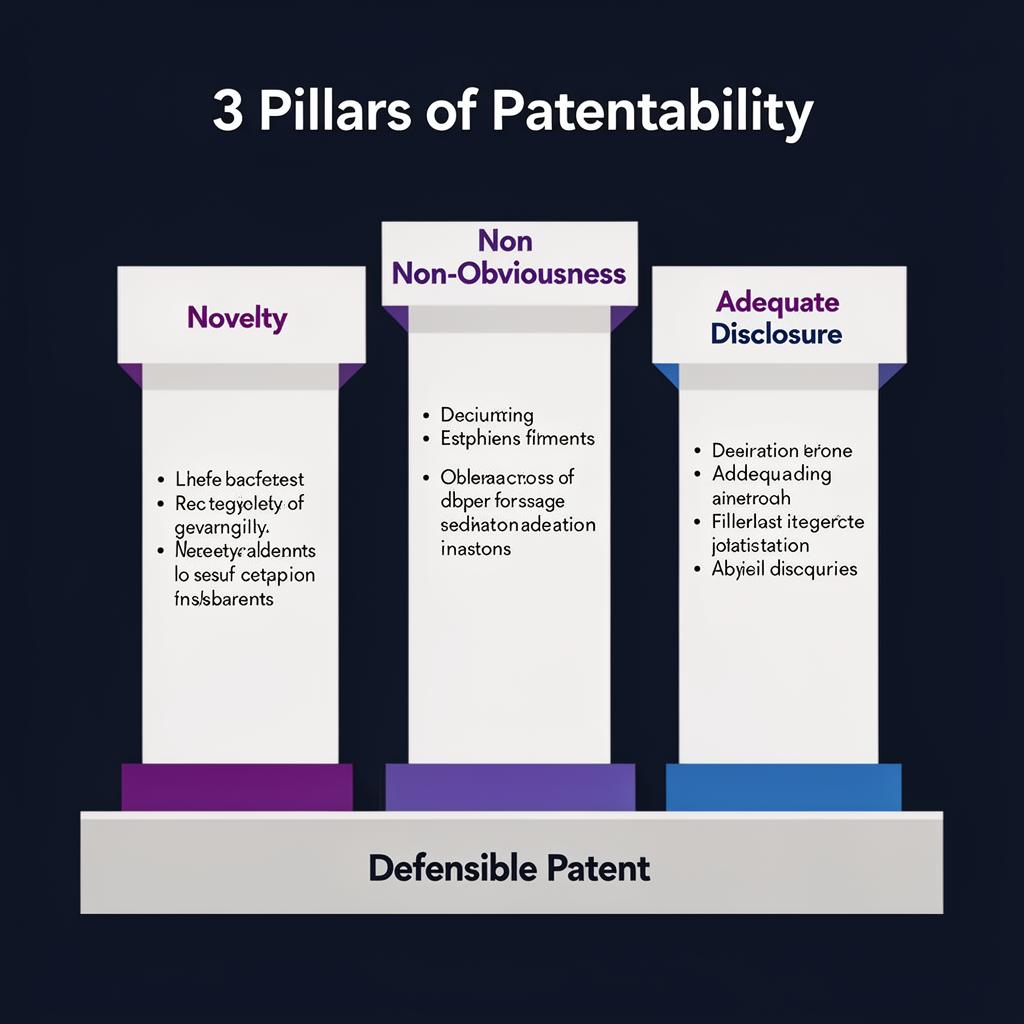
Every patent application must satisfy three fundamental requirements. If any one is missing, the application fails.
Pillar 1: Novelty
Your invention must be new. No single prior art reference can describe every element of your claimed invention.
- It's absolute: Novelty is judged against all prior art worldwide, in any language, at any time
- Your own disclosures count: Public disclosure more than one year before filing destroys novelty under U.S. law. Most foreign countries have no grace period.
- Confidential disclosures are okay: Disclosures under NDA generally don't count as public
- Every element matters: If prior art shows A, B, C but not D, your A+B+C+D invention is novel (with respect to that reference)
Pillar 2: Non-Obviousness
Even if your invention is novel, it must also be non-obvious to a person of ordinary skill in your technology area.
- The combination test: An examiner can cite multiple references and argue the combination would have been obvious
- Motivation to combine: The examiner must provide a logical reason why someone would combine the references
- Secondary considerations: Commercial success, long-felt need, failure of others, and unexpected results can all support non-obviousness
- Hindsight bias: Once you know the invention, it's easy to trace a path from prior art. Patentability must be judged without that knowledge.
Pillar 3: Adequate Disclosure
Your application must describe the invention in sufficient detail for a skilled person to reproduce it:
- Enablement: Enable a skilled person to practice the full scope of the claimed invention
- Written description: Demonstrate that you actually possessed the invention at filing time
- Best mode: Disclose the best way you know to practice the invention
How to Evaluate Whether Your Invention Is Patentable
Step 1: Define the Invention Precisely
- What it does: the function or result the invention achieves
- How it works: the specific mechanism, process, or structure
- What's different: how your approach differs from existing solutions
- Why it's better: the advantages over existing approaches
Step 2: Conduct a Prior Art Search
Search patent databases (USPTO, Google Patents, Espacenet), academic literature, and product documentation. For detailed guidance, see our companion article on prior art search best practices.
Step 3: Perform a Novelty Analysis
For each prior art reference, create a comparison chart listing your features and checking coverage. If no single reference covers all features, your invention passes the novelty test.
Step 4: Perform a Non-Obviousness Analysis
- Could a skilled person combine references to arrive at your invention?
- Is there a reason in the prior art motivating this combination?
- Are there objective indicators of non-obviousness?
Step 5: Evaluate Disclosure Sufficiency
Can you describe your invention in enough detail for reproduction? If parts rely on undocumented techniques, plan how to disclose enough for enablement while protecting sensitive details.
Common Pitfalls That Kill Patent Applications
- Public disclosure before filing: Trade shows, conferences, product launches, investor pitches without NDAs, social media posts, YouTube videos
- Insufficient technical detail: "A system that optimizes supply chains" is not patentable. The specific algorithms and architecture are.
- Overclaiming: Claims broader than what the specification supports will be rejected
- Ignoring the competition: Not knowing what competitors have patented creates both prior art risk and infringement liability
- Treating patents as an afterthought: Patent strategy should be integrated into product development from the beginning
The Patent Development Process: Step by Step
Phase 1: Invention Disclosure
- Names and contributions of all inventors
- Date of conception and reduction to practice
- Detailed description with drawings or diagrams
- Known prior art and how the invention differs
- Potential commercial applications
- Any public disclosures already made
Phase 2: Prior Art Search and Assessment
Conduct a thorough search and evaluate novelty and non-obviousness. This determines whether to proceed and shapes the claim strategy.
Phase 3: Application Drafting
- Specification: Detailed description, background, and advantages over prior art
- Drawings: Figures illustrating structure, components, and operation
- Claims: The legal definition of what the patent covers
- Abstract: Brief summary for search and classification
Phase 4: Filing and Prosecution
File with the USPTO. The examiner reviews, issues office actions, and the applicant responds. This process typically takes two to four years for utility patents.
Phase 5: Grant and Maintenance
Once allowed, pay the issue fee. Then maintain through periodic maintenance payments at 3.5, 7.5, and 11.5 years. See our guide on patent fees and portfolio strategy.
Patentability Self-Assessment Checklist
- Can you describe the invention in specific technical terms (not just the business outcome)?
- Does the invention include a novel feature or combination not found in any single prior art reference?
- Would a skilled person find the invention non-obvious?
- Can you describe it in enough detail for reproduction?
- Have you avoided public disclosure, or are you within the one-year grace period?
- Does the invention have commercial value justifying patent costs?
- Have you identified all co-inventors?
- Have you documented development with dates, lab notebooks, or version control?
The Value of Working with an Experienced Partner
- Objective evaluation: Experienced partners provide objective assessment of patentability and commercial potential
- Strategic claim drafting: Maximize scope while avoiding prior art pitfalls
- Prosecution efficiency: Reduce the number of office action rounds needed
- Portfolio strategy: Individual patents are most valuable as part of a broader, cohesive portfolio
How Idea Partnership Can Help
We support inventors through the discovery phase: invention disclosure, prior art research, technical documentation, and portfolio planning. Drafting, filing, and prosecution are handled by independent licensed patent attorneys, who also provide any legal advice.
We work across software, mechanical engineering, blockchain, business methods, and trade secrets.
If you have an invention worth protecting, contact us. We can help you organize the technical record and plan next steps with qualified patent counsel.
Want more IP strategy insights?
Get our latest guides, patent tips, and analysis delivered to your inbox. Join founders and IP leaders.
Disclaimer: This content is for informational purposes only and does not constitute professional legal advice. Please consult with qualified patent professionals before making patent strategy decisions.
Ready to protect your innovation?
Book a free strategy call with our team. We will identify patentable ideas in your business during the conversation.
Book a Free Info Call