
What You Will Learn
- 1USPTO fees increased in January 2025 with further revisions in March 2026
- 2Micro entity status provides a 75% discount on most fees, saving thousands per patent
- 3Provisional applications buy 12 months of patent pending status for as little as $80
- 4Continuation strategies let you build layered portfolio protection over time
- 5Annual portfolio pruning redirects maintenance dollars toward higher-value filings
The USPTO's fee schedule has changed in recent years and is subject to further revision over time. For companies and individual inventors building patent portfolios, fee changes can meaningfully affect the economics of patent protection, so current fees should always be confirmed directly with the USPTO or your patent attorney.
Higher fees don't necessarily mean less protection. With strategic planning, it may be possible to build a cost-effective IP portfolio that makes efficient use of your budget. At Idea Partnership, we help inventors and companies think through the patent fee landscape as part of broader portfolio strategy, working alongside your patent attorney on the legal and filing details.
Understanding the Fee Increases
Filing, Search, and Examination Fees
Basic fees for filing a utility patent application (large entity):
- Filing fee: $320 (up from $300)
- Search fee: $700 (up from $660)
- Examination fee: $800 (up from $760)
- Total basic filing cost: $1,820 (up from $1,720)
Issue Fees
- Issue fee (utility patent): $1,200 (up from $1,000)
Maintenance Fees
- 3.5-year: $2,000 (up from $1,600)
- 7.5-year: $3,760 (up from $3,600)
- 11.5-year: $7,700 (up from $7,400)
Entity Discounts: Your Most Powerful Cost-Saving Tool
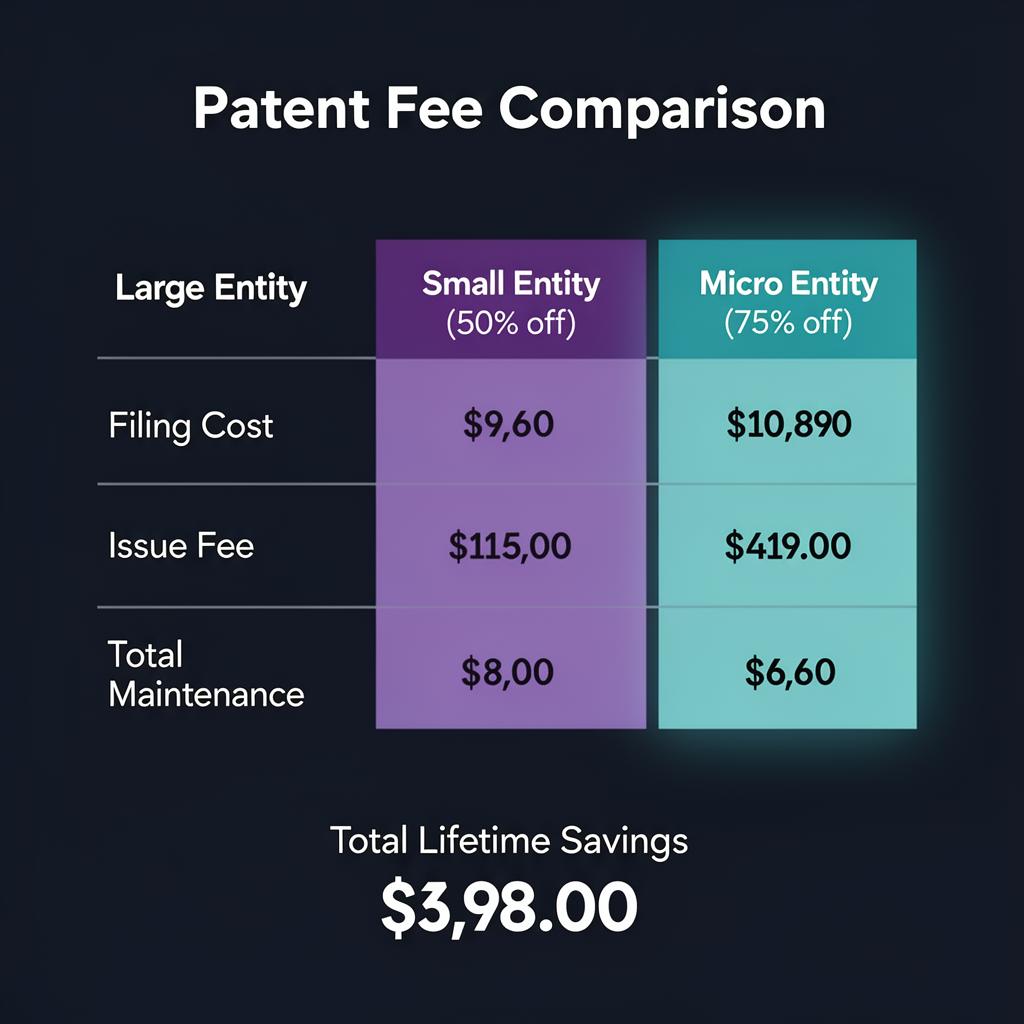
Small Entity Status (50% Discount)
Companies with fewer than 500 employees, individual inventors, and nonprofit organizations receive a 50% discount:
- Filing cost: $910 (vs. $1,820)
- Issue fee: $600 (vs. $1,200)
- Total maintenance: $6,730 (vs. $13,460)
Micro Entity Status (75% Discount)
To qualify as a micro entity:
- Qualify as a small entity (fewer than 500 employees)
- Not named as inventor on more than four previously filed patent applications
- Gross income below three times the median household income (~$240,000)
- No assignment obligation to an entity exceeding the income limit
Common Entity Status Mistakes
- Claiming wrong status: Verify eligibility carefully before filing
- Forgetting to claim status: Many small companies pay full rates unnecessarily
- Not updating status: Company growth or downsizing changes eligibility
Provisional vs. Non-Provisional: Strategic Filing Decisions
Provisional Patent Application
A provisional application provides a filing date and "patent pending" status for 12 months at a fraction of the cost:
- Large entity: $320
- Small entity: $160
- Micro entity: $80
When Provisional Filing Makes Sense
- You need to establish a filing date quickly (product launch, conference, investor demo)
- The invention is still evolving and may change over 12 months
- Budget constraints require deferring full application costs
- Market validation is needed before committing to prosecution
When to Skip the Provisional
- Invention is fully defined: File non-provisional directly to avoid added cost
- Need claims examined now: For due diligence, partnerships, or competitive positioning
- International filing is planned: The 12-month provisional period can conflict with foreign filing deadlines
Continuation Strategies for Portfolio Building
A continuation application claims the benefit of an earlier-filed application's priority date, allowing different claims from the same specification:
- Continuation: Same specification, different claims for broader or alternative coverage
- Continuation-in-part (CIP): Adds new matter when the invention has been improved
- Divisional: Required when the examiner finds multiple distinct inventions
Strategic Use of Continuations
- Layered protection: Target different aspects of your technology, making it harder for competitors to design around
- Adaptive claiming: As competitors implement similar technologies, file claims covering their implementations
- Cost spreading: File over time across multiple budget cycles
Maintenance Fee Strategy
The Decision to Maintain or Abandon
Not every patent is worth maintaining for its full 20-year term. At each maintenance window, evaluate:
- Commercial relevance: is the technology still commercially relevant?
- Competitive value: does it prevent competitors from entering your market?
- Licensing potential: could it generate licensing revenue?
- Defensive value: does it protect against infringement claims from others?
If the answer to all four is "no," letting the patent lapse and redirecting those dollars toward new filings may be the right decision.
Portfolio Pruning Best Practices
- Annual portfolio review: Categorize each patent as "core," "strategic," or "candidate for abandonment"
- Align with business strategy: Exited a market? Those patents may not justify maintenance
- Consider sale or assignment: Patent brokers can help you monetize unwanted patents
International Filing Considerations
The PCT Route
A single PCT application establishes a filing date in over 150 member countries, giving you up to 30 months to decide which countries to enter:
- International filing fee: ~$1,500 (with electronic filing discount)
- International search fee: $2,080 (USPTO as ISA)
- National phase entry: $500-$3,000 per country
Strategic Country Selection
- Countries where your products are manufactured
- Countries where your products are sold (key markets)
- Countries where competitors operate (create leverage)
- Countries with strong licensing ecosystems (Germany, China, South Korea)
Cost-Effective Portfolio Building: A Decision Framework
- Tier 1 (file immediately): Core innovations defining your competitive advantage for 5+ years. File non-provisional with comprehensive claims.
- Tier 2 (file provisional, evaluate): Promising innovations needing market validation. File provisional and evaluate within 12 months.
- Tier 3 (document, defer): Incremental improvements. Document in invention disclosures but defer filing.
- Tier 4 (protect as trade secrets): Hard-to-reverse-engineer innovations. Protect through trade secret programs instead.
How Idea Partnership Can Help
Building a cost-effective patent portfolio requires balancing legal protection with business economics. Our consulting services include patent portfolio planning, filing strategy development, maintenance fee analysis, and ongoing portfolio management.
To learn more, review our pricing page or contact us for a consultation.
Want more IP strategy insights?
Get our latest guides, patent tips, and analysis delivered to your inbox. Join founders and IP leaders.
Disclaimer: This content is for informational purposes only and does not constitute professional legal advice. Please consult with qualified patent professionals before making patent strategy decisions.
Ready to protect your innovation?
Book a free strategy call with our team. We will identify patentable ideas in your business during the conversation.
Book a Free Info Call