
What You Will Learn
- 1Skipping prior art search is the most expensive mistake in patent development
- 2A $3,000 search can save $15,000+ in wasted filing and prosecution costs
- 3Non-patent literature (academic papers, GitHub repos, product docs) is the most overlooked source of prior art
- 4The USPTO's new automated search tools mean examiners are finding more prior art than ever
- 5A structured four-phase search process produces the strongest patent applications
Many experienced patent professionals consider a thorough prior art search one of the most valuable steps you can take before filing a patent application. Yet it's a step that inventors and companies frequently skip or shortchange.
That perspective is wrong, and it's expensive. At Idea Partnership, skipping or shortcutting the prior art search is the most common mistake we see, and it leads to weaker patents, wasted prosecution costs, and unpleasant surprises.
What Is Prior Art?
Prior art is any evidence that your invention was already known before your patent application's effective filing date. It includes:
- Patents and published patent applications from any country, in any language
- Academic publications: journal articles, conference papers, dissertations, and technical reports
- Product literature: manuals, marketing materials, data sheets, catalogs
- Online publications: blog posts, forum discussions, GitHub repositories, white papers, archived web pages
- Public demonstrations: trade show presentations, product demos, public beta releases
- Foreign-language publications: prior art has no geographic or language boundaries
Why Prior Art Search Matters
It Saves You Money
A comprehensive prior art search typically costs meaningfully less than a full patent application, though exact costs vary by technology area, provider, and scope, and should be confirmed with your patent counsel.
Consider three scenarios:
- Skip the search: File broadly, the examiner finds close prior art, and you spend additional money narrowing claims, often ending up with a weaker patent and higher total cost.
- Search first: A search reveals close prior art, claims are refined before filing, and prosecution tends to go more smoothly, often for a lower total cost and a stronger patent.
- Search reveals anticipation: A search shows the core invention may already be anticipated, so resources can potentially be redirected before a filing is made, though this determination should be made with your patent attorney.
It Strengthens Your Patent
A patent drafted with awareness of the closest prior art is fundamentally stronger:
- Define your invention precisely: Claims drafted to clearly distinguish over the closest prior art are harder to reject or invalidate
- Tell a better story: Your specification can explain why existing solutions are inadequate
- Anticipate examiner objections: Preemptively address likely rejections, reducing office actions
It Informs Your Business Strategy
- Competitive landscape: Who else is working in your space? Where are the white spaces?
- Freedom to operate: Are there existing patents your product might infringe?
- Partnership opportunities: Discover potential partners or licensors
It Prevents Costly Surprises
How to Conduct a Thorough Prior Art Search
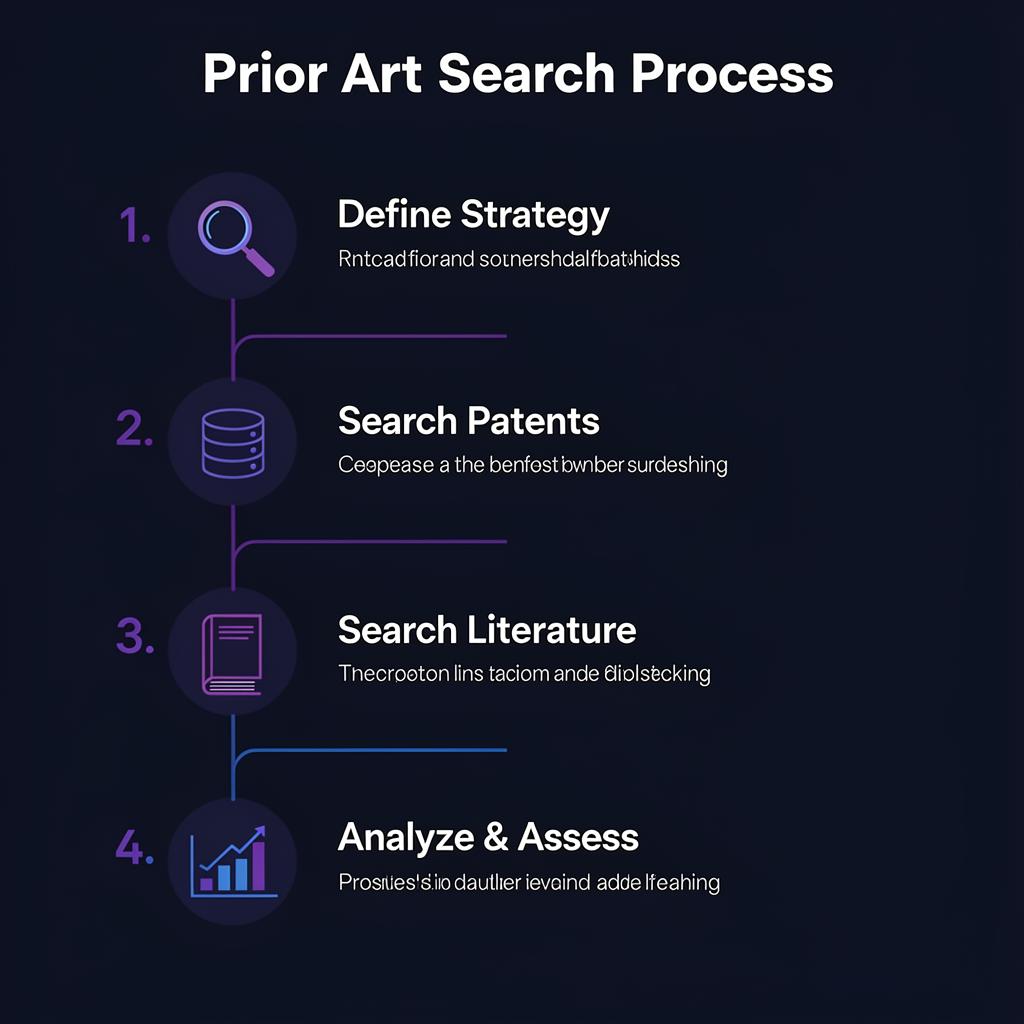
Phase 1: Define Your Search Strategy
- Identify the core invention: strip away implementation details to find the fundamental concept
- List key features: break the invention into component features as search targets
- Develop search terms: synonyms, related terms, and alternative descriptions for each feature
- Identify relevant CPC classification codes for structured patent searching
Phase 2: Search Patent Databases
- USPTO PatFT/AppFT: Free, comprehensive, searchable by keyword, classification, inventor, assignee, and date
- Google Patents: Covers multiple jurisdictions with semantic (concept-based) searching
- Espacenet: European Patent Office database covering 100+ countries
- WIPO PATENTSCOPE: PCT applications from around the world
- Commercial databases: Derwent Innovation, PatSnap, Orbit Intelligence for advanced analytics
Phase 3: Search Non-Patent Literature
- Academic databases: Google Scholar, IEEE Xplore, ACM Digital Library, PubMed, arXiv
- Technical standards: IEEE, ISO, W3C, IETF
- Product documentation: Manuals, spec sheets, archive.org
- Open source repositories: GitHub, GitLab code committed before your filing date
Phase 4: Analyze and Assess
- Create a comparison chart: Feature-by-feature comparison of each reference against your invention
- Assess novelty: Does any single reference disclose all features?
- Assess non-obviousness: Could a skilled person combine references to reach your invention?
- Identify the gaps: The features not found in any reference define your patentable innovation
The USPTO's Automated Search Pilot Program
In 2025, the USPTO launched its Automated Search Pilot Program using internal tools to assist examiners. Key implications:
- Examiners are finding more prior art: Automated tools help identify references more quickly and comprehensively
- Semantic search capabilities: Concept-based searching goes beyond keyword matching
- Faster examination: Reduced pendency could mean faster initial office actions
Prior Art Search Checklist
- Define the core invention and list all key features
- Develop comprehensive search terms including synonyms and related concepts
- Identify relevant CPC classification codes
- Search USPTO granted patents and published applications
- Search international patent databases (Espacenet, PATENTSCOPE)
- Search Google Patents for broader coverage and semantic matching
- Search academic literature (Google Scholar, IEEE, ACM)
- Search technical standards and specifications
- Search product documentation and marketing materials
- Search open source code repositories
- Create feature-by-feature comparison charts for the closest references
- Assess novelty: does any single reference anticipate the full invention?
- Assess non-obviousness: could references be combined to reach the invention?
- Identify the patentable gap: what's truly new about your invention?
- Document your search strategy and results for future reference
When to Hire a Professional
- Access to premium databases: Commercial databases with enhanced search capabilities and citation analytics
- Experienced analysis: Judgment from reviewing thousands of references across a technology area
- Objectivity: An outside searcher provides perspective that inventors naturally lack
- Documentation: Professional search reports provide evidence for prosecution and potential litigation
How Idea Partnership Approaches Prior Art
At Idea Partnership, prior art search is an integral part of our IP development process. Our approach includes:
- Technology landscape mapping: Before focusing on a specific invention, we map the broader landscape to identify trends and white spaces
- Multi-source searching: Patent databases, academic literature, product documentation, and industry publications
- Strategic claim shaping: We use findings to maximize protection for the truly novel aspects
- Ongoing monitoring: Track new publications and patent filings in your technology areas
If you're developing innovations and want support thinking through your patent strategy alongside qualified patent counsel, contact our team.
Want more IP strategy insights?
Get our latest guides, patent tips, and analysis delivered to your inbox. Join founders and IP leaders.
Disclaimer: This content is for informational purposes only and does not constitute professional legal advice. Please consult with qualified patent professionals before making patent strategy decisions.
Ready to protect your innovation?
Book a free strategy call with our team. We will identify patentable ideas in your business during the conversation.
Book a Free Info Call